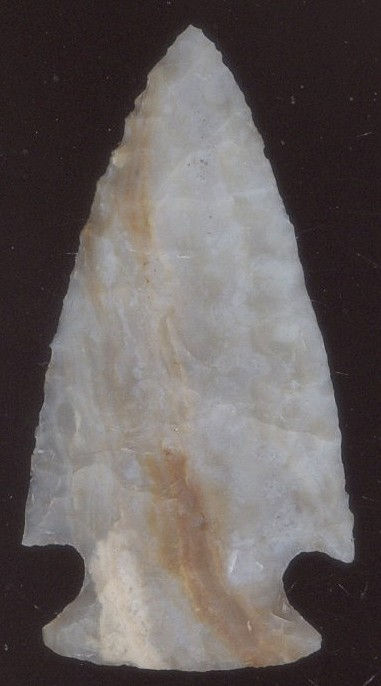
About Alibates Points.
About Alibates agatized dolomite. The main ancient quarries cover about 60 acres within the Alibates Flint Quarries National Monument, which is on a bluff overlooking the Canadian River in the northern Texas Panhandle. Since collecting on federal land is prohibited, the material I got came from the excavation of a gas line through a nearby private ranch. Though called flint by most, Alibates is really an agatized dolomite; it is massive and bedded like Flint Ridge, and the Indians dug pits and mined it in the same way. Colors range from white, yellow, brown, red, and purple, with mottled combinations and variations. The most recognizable form of Alibates has been called "beef steak" because of its red and white marbled appearance. In its raw state, Alibates can be fairly tough, and some of it is OK without heat treating. However, most of it I have carefully cooked at lower temperatures. This stone was a favorite with the local Paleo Indians; a lot of fluted points and lanceolates were made from it. The Archaic, Plains Village, and Pueblo cultures used it. A lot of beautiful Washita points and four-bevel Harahey knives came out of it, and the Caddo people also made some nice biface blades from it. The 200 pounds I got over 30 years ago was from a guy who was making sawed blanks, and it was too fractured up to safely put through his saws. However, I broke the big chunks up the old-fashioned way and got some sizable preforms and a bucket full of smaller blanks that would make nice projectile points. Now, it’s time to do something with what I have left of this unique and scarce material. Note, due to its nice color and durability, Alibates points would go good on necklaces!